
Colorado Parole Board Authority
The formal agency is the Colorado State Board of Parole. Its nine full-time members are appointed by the governor, confirmed by the Colorado Senate, and serve staggered three-year terms. Under C.R.S. §§ 17-2-201, 17-22.5-403, and 17-22.5-404, the Board evaluates eligible people for release to Division of Adult Parole supervision, sets parole conditions, addresses rescission, hears alleged violations, and reviews early-discharge requests.
The Board is not the source for an ordinary bond release from a county jail. It acts within the state-prison and parole framework. Reaching PED, the estimated parole eligibility date, permits consideration under the law that governs the sentence. It does not create an automatic right to discretionary release. The Board’s outcome, a workable parole plan, and other custody issues can stand between a hearing date and physical release.
The Colorado State Board of Parole home page is the official starting point for Board functions and publications.
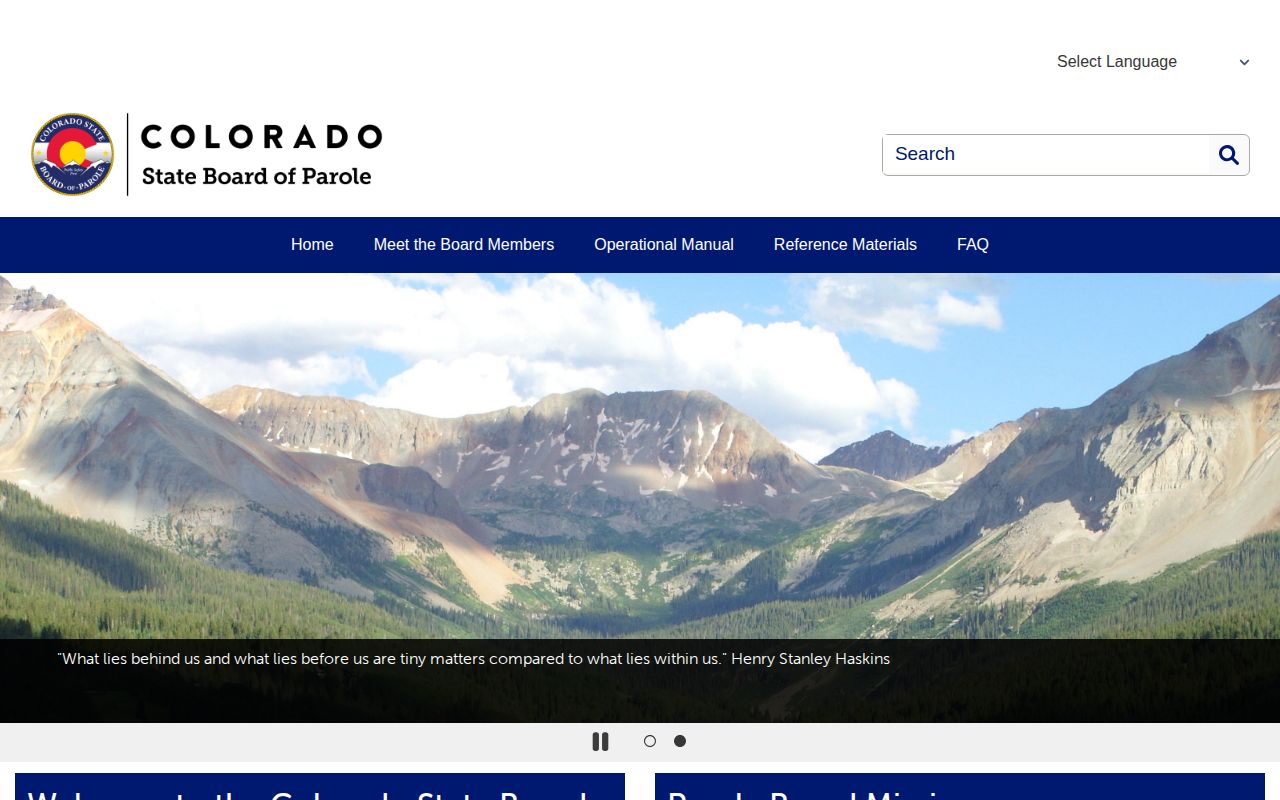
The agency page establishes the Board’s statewide role, while the separate live calendar supplies the scheduled events.
- PED
- The estimated date when the governing law first allows parole consideration.
- Application hearing
- A review of possible release after eligibility and before mandatory release timing.
- Rescission hearing
- A review of a granted release date after a later issue may justify changing it.
- Revocation hearing
- A hearing on an alleged violation after release to parole.
Find Colorado Parole Hearing Dates
The official live calendar is a current and upcoming schedule, not a permanent archive of every past event. On August 12, 2026, it displayed monthly views from August through November 2026. A reader could hover over a date for that day’s schedule and select a title for a larger calendar. Future months appear after scheduling is set. The Board warns that schedules may change, so a date should be checked again close to the event.
- Open the official live Parole Board calendar rather than a copied or saved schedule.
- Choose the current or upcoming month in which the hearing is expected.
- Hover over the relevant date to view the day’s scheduled entries.
- Select the calendar title when a larger view is needed.
- Compare the event with the correct CDOC profile and next-hearing field.
- Recheck near the date because DOC schedule changes appear the following business day.
The live Colorado Parole Board calendar is the person-specific public schedule source.
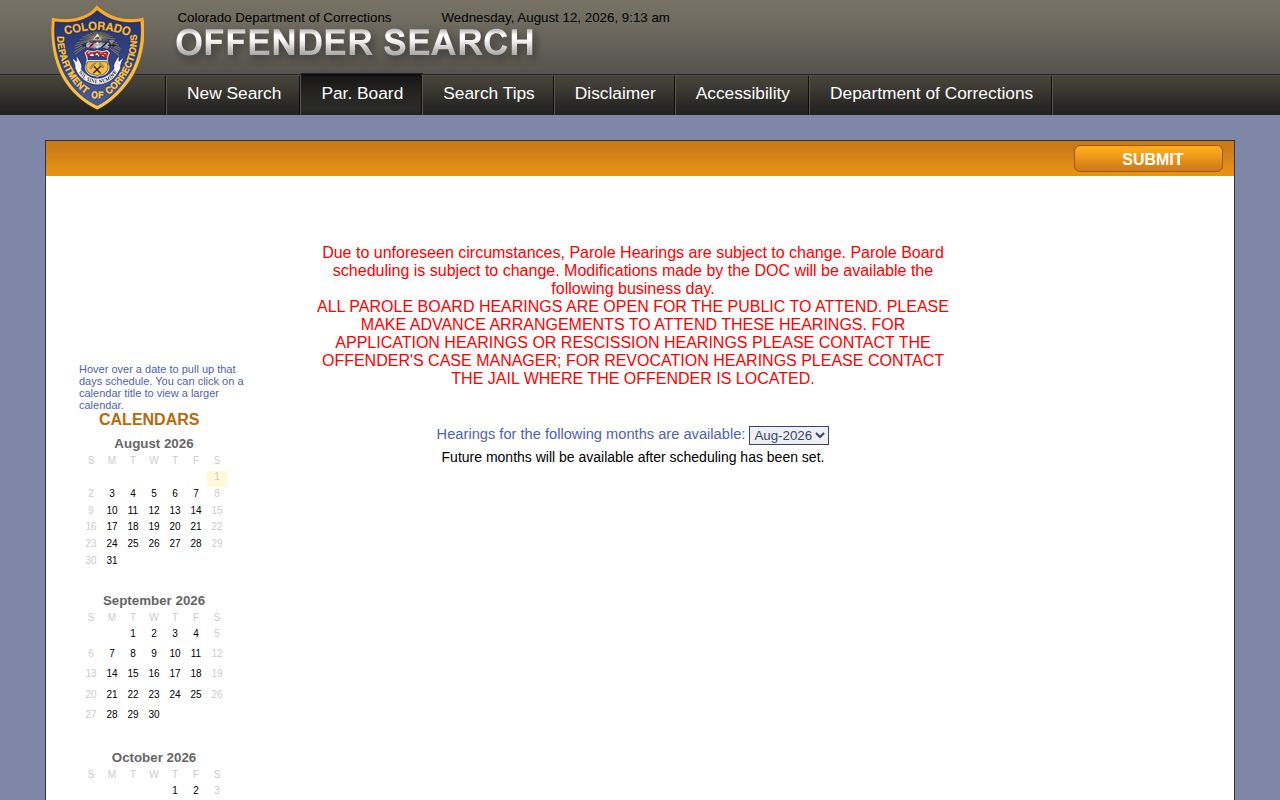
The monthly interface should be treated as a changing operational calendar, not proof that a hearing occurred exactly as first posted.
Attend Colorado Parole Hearings
Colorado parole hearings are open to public attendance, but advance arrangements are required. For an application or rescission hearing, the live calendar directs the public to contact the offender’s case manager. For a revocation hearing, the public must contact the jail holding the person. Those paths differ because the person and the record may be under different operational control.
Attendance access does not turn the calendar into an individual decision record. The event may be moved, waived, handled through file review, or changed because the person is unavailable, in movement, at court, in a jail, or in fugitive status. The Board’s FY 2024 workload data includes each of those paths. Confirm the event type and current arrangements before relying on an earlier calendar entry.
Public attendance also does not authorize access to every underlying document. The schedule identifies the Board event. A written disposition identifies the result. Other corrections, medical, victim, or disciplinary materials may remain restricted even when the decision itself is an official action.
Note: The calendar proves a scheduled event, while the disposition establishes the Board’s recorded decision.
Colorado Parole Hearing Outcomes
The Board’s official analysis series uses outcome terms that carry specific meanings. At initial consideration, the result may be release, defer, table, or referral to the full Board. Full-board review may release, defer, or table. A tabled decision is not simply an approval or denial. It is a conditional discretionary release pending a stated requirement, such as completion of treatment or confirmation of a parole plan.
| Outcome | Meaning | What comes next |
|---|---|---|
| Release | The Board approves discretionary parole under stated terms | Planning, conditions, and lawful processing must occur before the actual exit |
| Defer | Release is not approved at that review | The decision sets or leads to a later review point under applicable rules |
| Table | Conditional Discretionary Release Pending a requirement | Release may follow if the condition is met; otherwise the order can be changed to defer |
| Full-board referral | The matter moves beyond the initial panel | The full Board conducts the next level of review |
| Rescission action | A previously granted release date is reconsidered | The Board may keep or revise the prior release action |
A release outcome does not prove same-day freedom from all custody. CDOC processing, parole planning, a detainer, another jurisdiction, community corrections, or a later Board action can affect the destination and timing. The actual prison-release event should be confirmed with CDOC.
Find Colorado Parole Decisions
Colorado does not publish a verified authoritative database where a name search returns every individual Board decision. The State Publications Library hosts annual and analytical reports about Board decisions, but those publications summarize groups and trends. They do not prove what happened in one named case. The public CDOC profile and live calendar are the person-specific interfaces, and neither replaces the written Board disposition.
Use this record path after the scheduled event:
- Recheck the live calendar to make sure the hearing was not moved or changed.
- Open the matching CDOC profile and review the next-hearing field, current assignment, and estimated dates.
- Do not infer the outcome solely from a changed date or assignment.
- Request the identifiable Board disposition, using the full name, DOC number, hearing date, and event type.
- Confirm a resulting prison release through CDOC’s release or time-computation record.
Colorado Parole Decision Archive
The State Publications Library parole-decision archive supplies the aggregate analysis series.
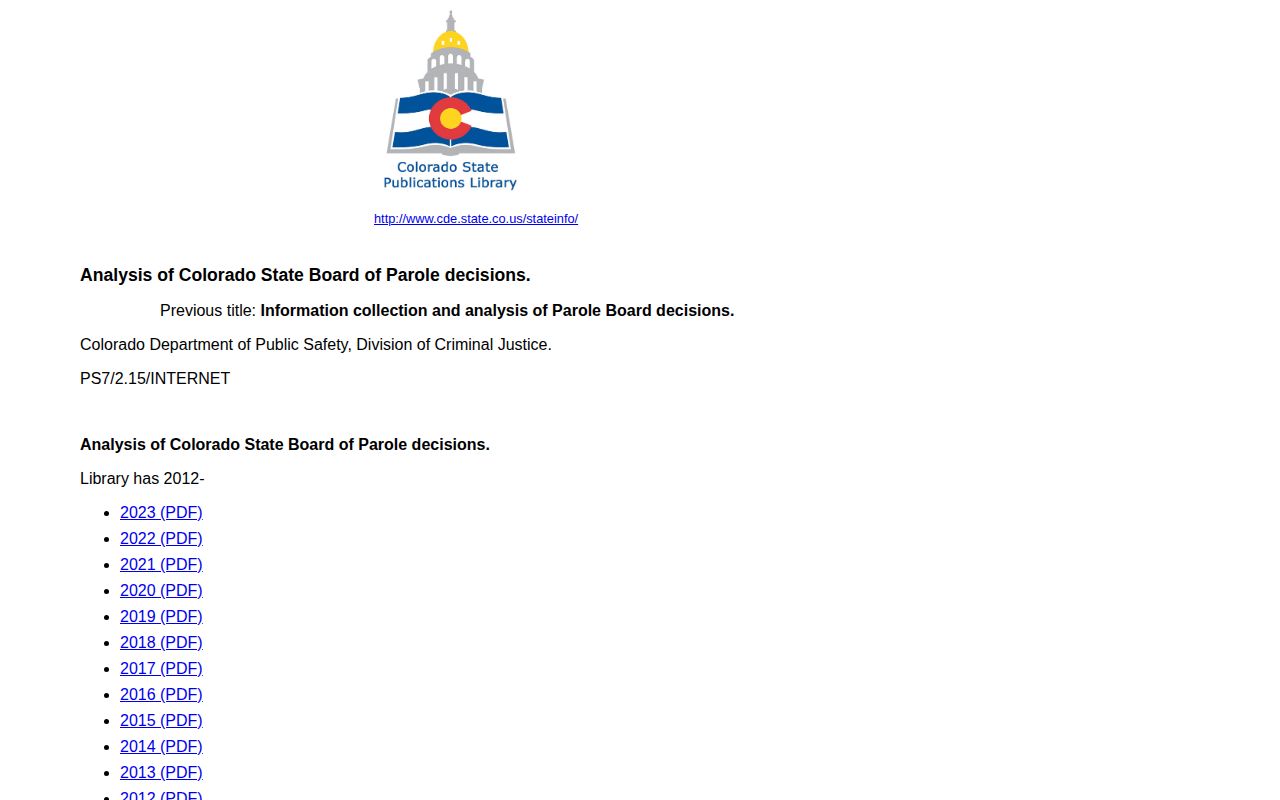
The archive is valuable for statewide patterns and defined outcome categories, but an individual disposition must come from the Board record.
Colorado’s criminal-justice-records law treats decisions that grant, order, or terminate parole as official action. That supports a narrow request for the decision. It does not open the complete prison, medical, disciplinary, or victim file.
Note: Request the person’s disposition, not a broad file, when the hearing result is the fact needed.
Colorado Parole Hearing Eligibility
C.R.S. § 17-22.5-403 is the central eligibility statute for many Colorado sentences. Its general Part 4 framework places eligibility after half of the sentence, less authorized earned time, and permits an extension for misconduct. That broad rule has major exceptions. Offense date and type, prior convictions, crime-of-violence provisions, indeterminate terms, sexual-offense statutes, life sentences, and other sections can change or remove the ordinary path.
Proposition 128 changed treatment for specified crimes committed on or after January 1, 2025. It includes an 85 percent framework for listed violent offenses and full-sentence treatment before parole for a third qualifying crime of violence. Colorado is therefore neither a universal 50 percent state nor a universal 85 percent state. The sentence cohort and official CDOC time computation control.
PED should be read as a threshold for possible consideration. MRD is an estimated mandatory sentence-computation milestone. SDD is the estimated end of the governing sentence or jurisdiction. None is a substitute for the Board result. A profile can also show a Next Parole Board Hearing Date when applicable.
The CDOC Offender Search profile brings these person-specific dates together.
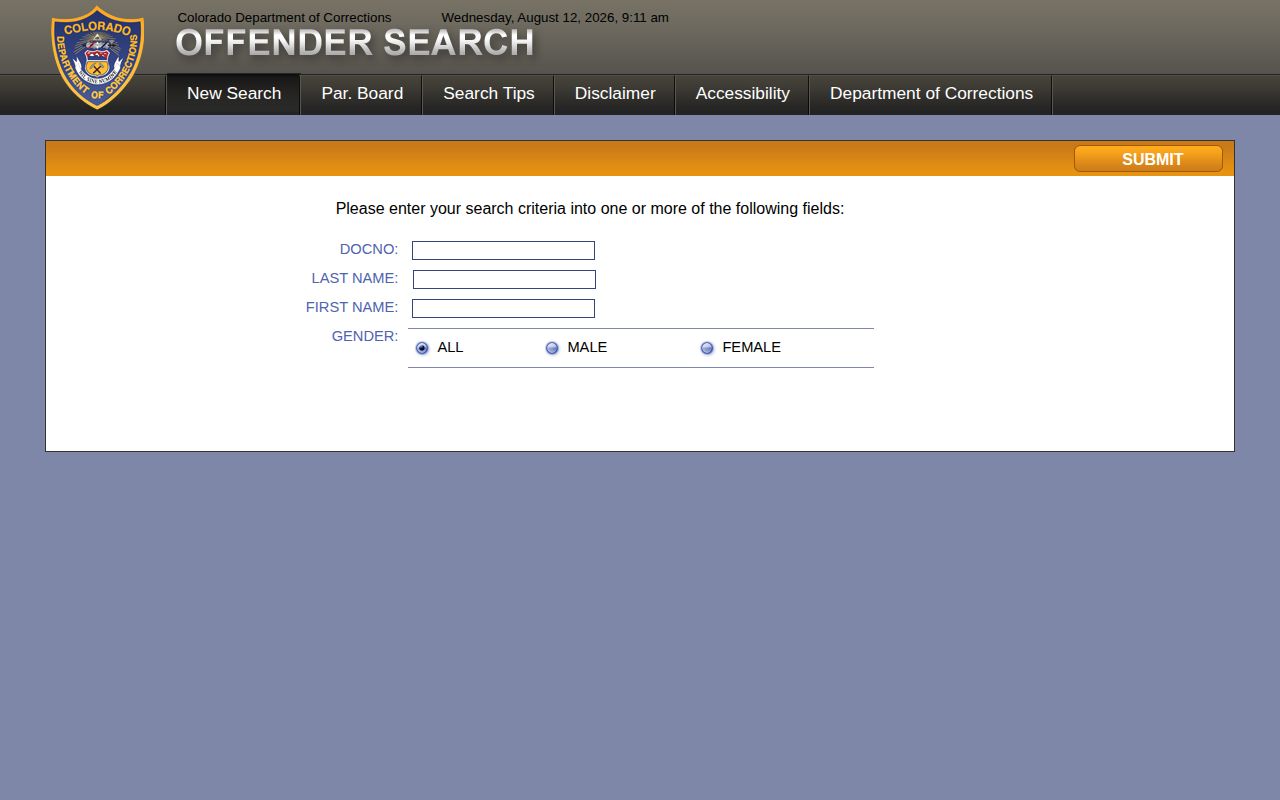
The profile links sentence timing to the hearing process, but the term “Est.” means each displayed date remains an estimate.
Colorado Parole Hearing Workload
The Board’s FY 2024 annual report provides scale, not a live count of releases. It recorded 11,042 application hearings. That total included 7,402 video or phone hearings, 1,583 file reviews, 1,280 matters involving refusal, unavailability, movement, a court or jail conflict, or fugitive status, and 591 administrative waiver or date-change matters.
The same report listed 1,231 full-board reviews, 176 rescission hearings, 2,183 revocation hearings, 2,354 early-parole-release reviews, 16 special-needs hearings, 22 interstate probable-cause hearings, and 1,816 warrants. These categories can overlap the broader work of the Board and should not be added up as if each figure represented a different person released that year.
The counts explain why calendar entries and decision types vary. Some matters concern first release consideration. Others review a prior grant, an alleged violation after release, an early-discharge request, or a procedural change. When a record only says “parole hearing,” identify the event type before interpreting what the result could mean.
Note: FY 2024 workload figures describe Board activity during that fiscal year, not current custody, release, or supervision for any named person.
Confirm Colorado Parole Release
A reliable confirmation chain uses three records. First, the calendar establishes that a hearing was scheduled. Second, the Board disposition establishes the decision. Third, the CDOC profile or release record shows how that decision affected custody and sentence timing. Skipping a link in that chain can turn an eligibility date into a false release claim or an aggregate report into a false individual result.
Current Facility Assignment helps after the hearing. A named prison indicates a prison assignment. A parole-region assignment is direct evidence that prison custody ended and CDOC parole supervision continues. A blank search result remains inconclusive because CDOC has not published a dependable retention period for every discharged profile. Search name variants and request the official record when necessary.
Release to parole is not final discharge. The Board may later address a violation or an early-discharge request, and a mandatory or sentence-discharge date may occur later. The Colorado parole and probation page explains the supervision record that follows release. County-jail bond and probation questions stay with the local jail, sentencing court, and judicial-district probation office.
Colorado Parole Release Sequence
The usual record sequence is sentence computation, eligibility, hearing, decision, release processing, parole supervision, and later discharge. Each step has its own source. CDOC computes PED, MRD, and SDD. The live calendar identifies a scheduled Board event. The Board disposition states the outcome. CDOC then records the current assignment and any release action. Adult Parole supervises the person after prison exit.
A break in that sequence needs careful reading. A tabled result may wait on treatment or a confirmed parole plan. A rescission matter may revisit an earlier grant. A detainer can move the person to another authority after CDOC’s prison custody ends. Community corrections may place the person in a structured setting. None of these paths is accurately described by saying only that the person “won parole.”
The final sentence milestone can also be misunderstood. Sentence discharge concerns the end of the governing sentence or jurisdiction. It is not always the first release from prison. Parole may continue between those two points, and a violation can return a person to confinement before discharge. Keep the hearing decision, the actual release record, and the later discharge record separate.
For a disputed sequence, request the individual Board disposition and the narrow CDOC time or release record. Include the full name, DOC number, hearing date, event type, and date range. Those details help the agencies identify the public action without implying that every part of the underlying file must be disclosed.