
CDOC Released Inmate Scope
CDOC runs Colorado’s state-prison system and supervises people released from prison to parole. Its public data follows state-corrections jurisdiction: a state-prison sentence, a release from a CDOC or contract prison to parole, a return on a parole matter, or eventual sentence discharge. That scope makes CDOC the right statewide source for a released state prisoner. It is not the primary source for every person arrested in Colorado.
A person who left a county jail after bond, dismissal, time served, or a county sentence belongs first to the sheriff’s release record and the court case. A later transfer into CDOC changes the source. Federal prison uses the Bureau of Prisons. Civil immigration detention uses ICE. These systems can follow one another, and the end of one agency’s custody does not settle another agency’s status.
The official CDOC home page identifies the Colorado Department of Corrections and its statewide functions.
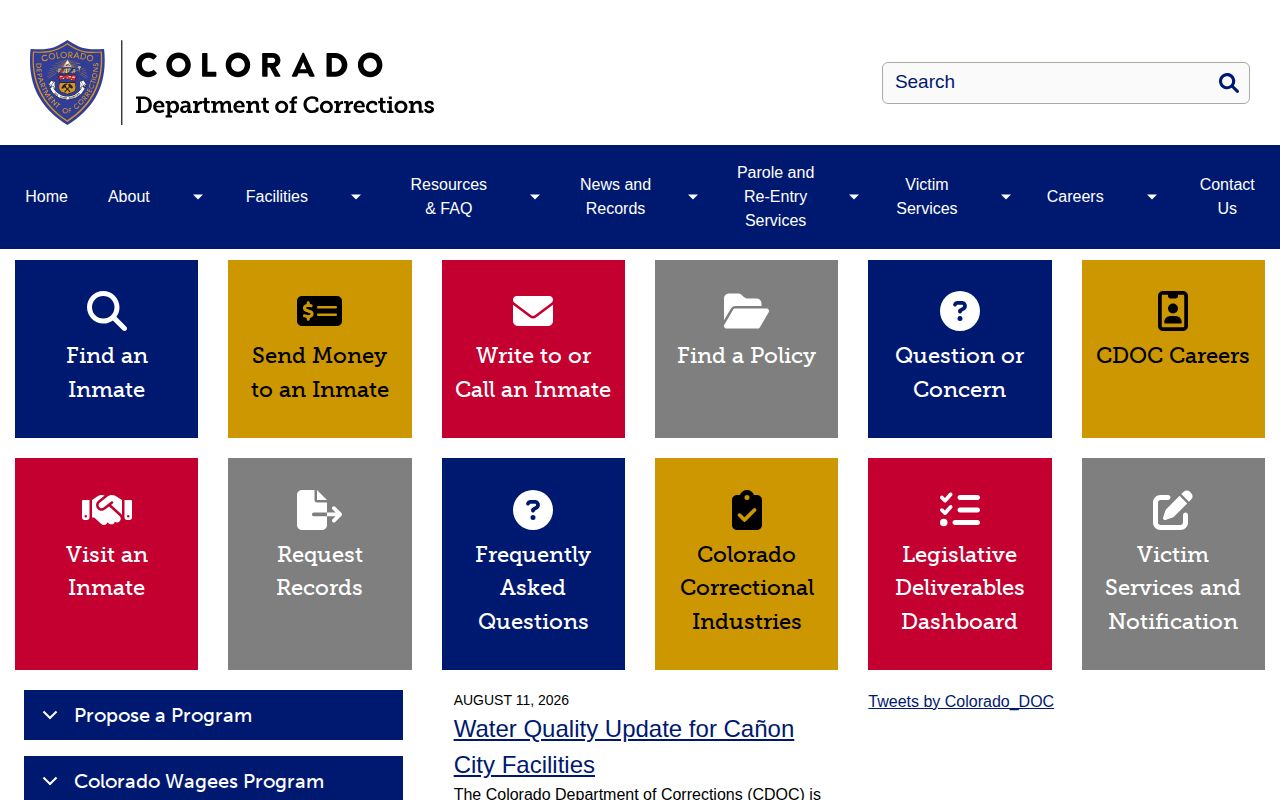
The agency site is the starting point for prison, parole, and public-record services, while the separate search application supplies person-level profiles.
- Parole
- Release from prison with CDOC community supervision still in force.
- Mandatory release
- A statutory sentence-computation milestone, subject to the law governing the sentence.
- Sentence discharge
- The endpoint of the governing sentence or jurisdiction, which need not be a same-day prison-gate exit.
- Detainer
- A request or authority that can lead to transfer to another custodian.
Use CDOC Offender Search
The live CDOC offender search offered DOCNO, last name, first name, and gender when verified on August 12, 2026. DOCNO accepts up to six numeric characters and is CDOC’s main public identifier. Search Tips says names match by prefix, so the first letters of a surname can retrieve several longer names. Two last names should be entered together without a hyphen. The name stored may be the one used at arrest or prosecution rather than a later legal name.
- Confirm that the person entered CDOC jurisdiction rather than only a county jail.
- Search by DOC number when known. Otherwise start with the last name.
- Add first name and gender only when they help narrow a broad result set.
- Compare DOC number, photograph, physical details, age, and conviction rows before choosing a profile.
- Read Current Facility Assignment and all estimated dates as separate fields.
- Confirm unclear or consequential details through an official CDOC record request.
The live CDOC Offender Search shows the active public query fields and matching profiles.
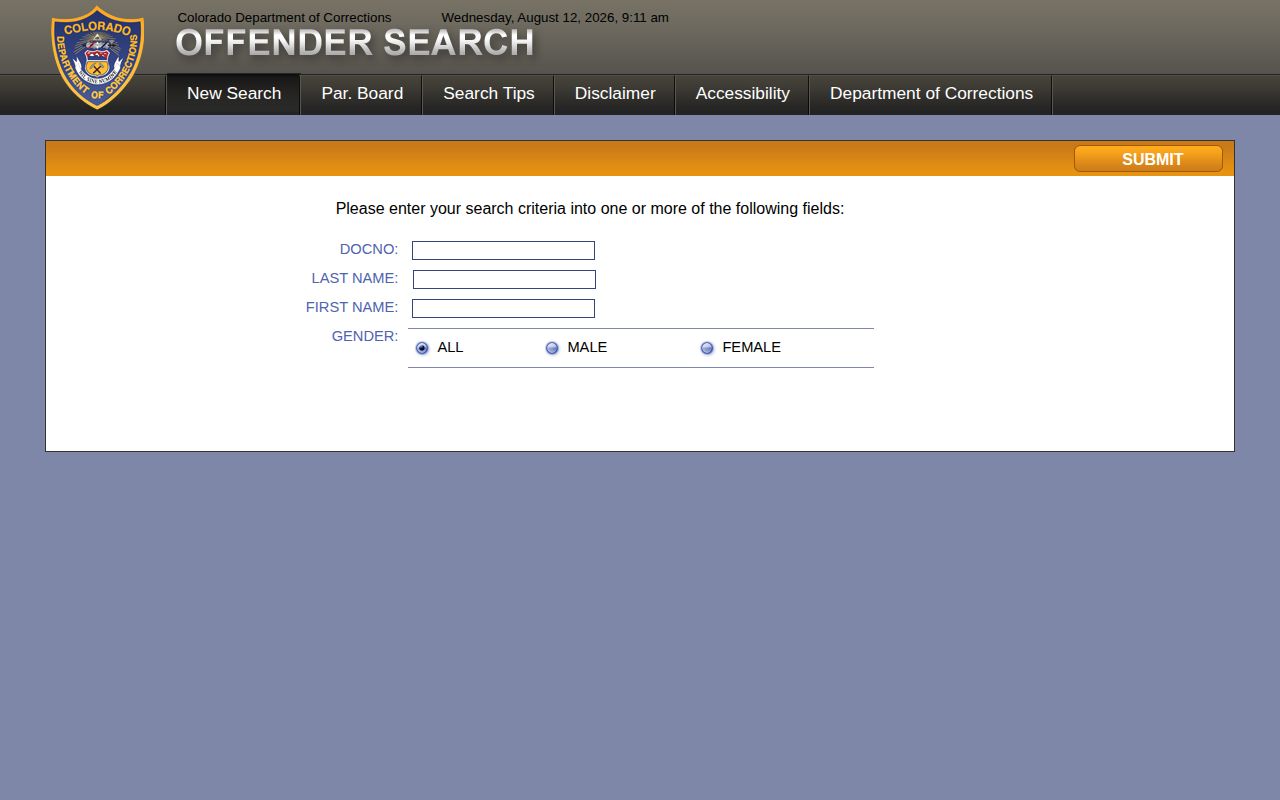
A common name should never be matched on name alone. The DOC number and conviction rows make a stronger identification.
CDOC Release Search Tips
Gender is a supplemental field. Leave it at “All” when uncertain, since a wrong filter can hide the correct result. A partial first name may also help, but broad prefix searches can return many records. Try known aliases and the name used during the criminal case if a current legal name fails. The legacy tips refer to date of birth, but date of birth was not an active visible field on the live form when the research was checked; its code was disabled.
The official CDOC Search Tips explains name prefixes, identifiers, and two-part surnames.
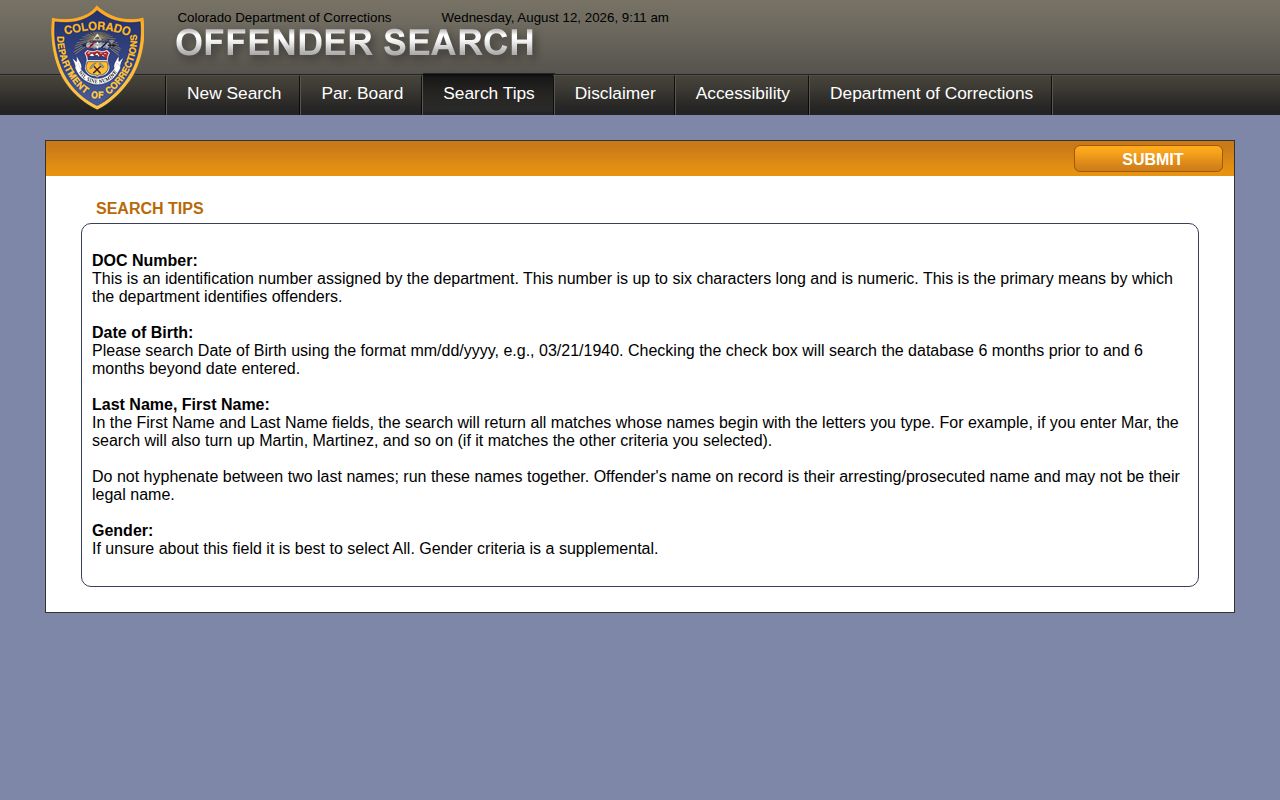
Those tips help expand a search, but they do not resolve how long a completely discharged profile remains available.
If no result appears, do not treat absence as proof that the person was never in CDOC or is now free of all custody. Recheck spelling and aliases, remove optional filters, then review the court case or ask CDOC for the public release action. A missing profile can reflect search terms, data limits, or an unknown retention practice.
Note: Name variants can recover a record, but a blank result still cannot establish final discharge or freedom from custody.
CDOC Released Record Fields
A CDOC profile has no single verified field called “Projected Release Date.” Colorado instead displays three estimated dates with different legal meanings. It may also list Current Facility Assignment and Next Parole Board Hearing Date. A named prison points to a prison assignment. A parole-region entry can show that physical prison custody ended while parole jurisdiction continues.
| CDOC field | How to read it |
|---|---|
| DOCNO | The six-digit-or-shorter numeric CDOC identifier used to distinguish profiles |
| Current Facility Assignment | A prison, a parole region, or another current assignment shown by the profile |
| Est. Parole Eligibility Date | PED, an estimated point when parole consideration may begin, not an order of release |
| Est. Mandatory Release Date | MRD, a sentence-computation milestone under the governing law |
| Est. Sentence Discharge Date | SDD, the estimated endpoint of the governing sentence or jurisdiction |
| Next Parole Board Hearing Date | A scheduled Board date when that field applies |
| Conviction rows and photograph | Details used with the DOC number to verify the correct person |
A 2025 federal court order reported a CDOC Current Facility Assignment of “Parole - Northeast Region” for a person then on parole. That is direct evidence of a searchable post-prison profile and a regional parole assignment. It proves release from prison with supervision. It does not prove sentence discharge.
The official result interface demonstrates why PED, MRD, and SDD must remain separate instead of being rewritten as one promised release date. The date rows need the assignment and custody history beside them.
CDOC Discharge Search Limits
CDOC does not publish a reliable retention period for profiles after complete discharge. The research also did not verify a universal post-discharge Current Facility Assignment label or a distinct historical “actual release date” field on every profile. It would therefore be inaccurate to say all discharged people remain searchable forever, or that every profile eventually shows the literal word “Discharged.”
Important: A parole-region assignment confirms release from prison with supervision, while an empty search result remains inconclusive.
The CDOC search disclaimer warns that its database may contain inaccurate information.
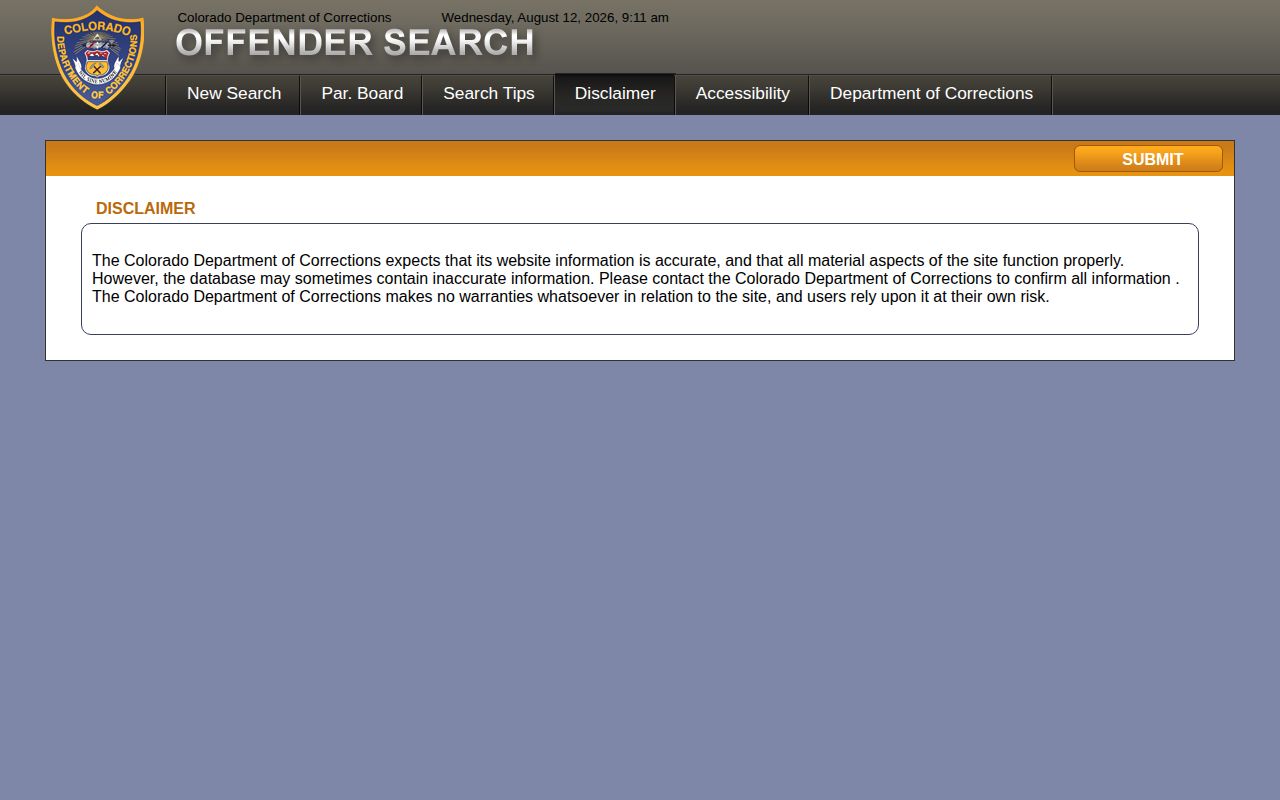
Use the public profile as a navigation and verification tool, then ask CDOC for the source record when the exact event matters.
Medical records follow a separate process. CDOC requires signed authorization to release another person’s medical record and uses different contacts for active-custody and history or parole medical material. A general offender-record request should not assume that protected health information is part of the public release record.
Note: Public release data and protected medical material follow separate CDOC request paths and disclosure rules.
CDOC Release Date Framework
Colorado law treats parole eligibility, discretionary parole, mandatory release, and sentence discharge as distinct milestones. Under the general Part 4 framework, C.R.S. § 17-22.5-403 often ties eligibility to a portion of the governing sentence less authorized earned time, but offense date, offense type, prior convictions, life or indeterminate sentences, and other provisions can change the rule. Colorado cannot accurately be called a universal “50% state” or “85% state.”
PED is generally an eligibility calculation, not a right to leave. MRD is generally based on the full maximum governing sentence, presentence confinement, credits, and applicable law. SDD tracks the estimated end of the governing sentence or jurisdiction. New convictions, consecutive sentences, parole revocation, and the balance of parole can change which sentence governs. Misconduct can also affect timing.
Earned time under C.R.S. § 17-22.5-405 depends on statutory eligibility, conduct, and documented progress. SB 26-159, signed in May 2026, changed certain monthly rates and added possible time for qualifying behavioral-health milestones. It did not give one automatic credit to every inmate. Proposition 128 created an 85% framework for specified violent offenses committed on or after January 1, 2025. The cohort and offense still control.
Note: The displayed word “Est.” signals a calculation that can change with credits, conduct, court action, or parole events.
CDOC Sentence Discharge Nuance
Sentence discharge is especially easy to misread. CDOC’s FY 2024 report counted 741 sentence discharges. Only 14 involved people who did not have to serve parole. The other 727 reached sentence discharge while incarcerated after a parole violation and before re-parole. In that setting, “sentence discharge” did not describe a routine same-day release from a prison gate into the community.
This Colorado-specific pattern shows why the custody sequence matters. A person can leave prison for parole, return after a violation, and later reach the sentence endpoint while incarcerated. Another person may reach discharge without supervision. A profile label, annual category, or date must be read with Current Facility Assignment, parole history, and the governing sentence.
Parole application, rescission, and revocation hearings also mark different stages. Application review considers discretionary release after PED. Rescission review can revisit a release date already granted. Revocation review addresses alleged conduct after release and can lead to reincarceration. These Board events are not county bond proceedings and do not all produce the same kind of release record.
CDOC’s FY 2024 figures make the distinction concrete. A sentence can reach discharge while the person is back in custody on a parole matter, just as prison custody can end while the sentence and parole supervision continue. The safest reading uses three separate questions: when did prison custody end, did parole then apply, and when did the governing sentence finally end? No single public date or assignment answers all three in every case.
CDOC Release Processing
CDOC does not report its release totals by the prison that appears on a profile. The FY 2024 statistical report says people frequently release through transport hubs. A last facility assignment therefore need not be the physical point where the final release paperwork, transport, or transfer occurred. The statewide facility list is useful for identifying an institution, but it should not be turned into a claim that each prison publishes its own release list.
Colorado’s 2025 version of C.R.S. § 17-22.5-202 provided for suitable clothing and allowed state-paid transport from a correctional facility to a Colorado residence or another in-state location. Applicability can vary by sentence cohort, so it should not be promised in every case. HB 26-1256 creates a future change beginning January 1, 2027, including at least a $100 discharge allowance free of deductions and changed identity-document procedures. Those terms were not current practice on the August 2026 research date.
Transfers further complicate the word release. CDOC statistics include releases to pending charges or detainers, hospital transfers, appeal bonds, and other court-ordered outcomes. One agency’s custody can end as another takes control. Community corrections may also be a structured residential placement rather than unrestricted return to the community.
Release-day aid and the legal custody record serve different purposes. Clothing, travel, an allowance, or identity documents can help with the transition, but none of those items proves the sentence endpoint. Likewise, a transport record can show where the person went without proving that parole or another hold ended. Keep the practical release plan apart from the legal time-computation record.
Note: A transport destination can identify the next stop without proving that supervision or another hold ended.
CDOC Released Inmate Trends
CDOC recorded 6,217 inmate releases in FY 2024, compared with 5,888 in FY 2023. That was a 5.6% increase. Parole made up 86.5% of the later year’s releases, sentence discharge 11.9%, and other types 1.5%. The FY 2024 average jurisdictional population was 26,732, including 17,362 inmates and 9,370 parolees.
| FY measure | Value | Meaning |
|---|---|---|
| 2023 inmate releases | 5,888 | Prior-year CDOC total |
| 2024 inmate releases | 6,217 | CDOC total, up 5.6% |
| 2024 parole share | 86.5% | Most exits began parole rather than final discharge |
| 2024 average parolees | 9,370 | Part of CDOC jurisdiction outside prison |
These are dated statewide measures. They are not a live released-inmate list and do not count all county-jail, federal, or ICE exits in Colorado. The parole share also reinforces that physical prison release often starts a new supervision stage rather than ending the entire sentence.
CDOC Versus County Release
Use CDOC when a person served a Colorado state-prison sentence or remained within state parole jurisdiction. Use the sheriff and court when the known event was a local arrest, pretrial detention, bond, dismissal, time served, or a county sentence. A transfer from jail into CDOC is not a community release, even though the county roster can stop showing the person.
| Question | CDOC | County jail |
|---|---|---|
| Who is covered? | State prisoners and parole jurisdiction | Local arrests, pretrial custody, and county sentences |
| Primary identifier | DOC number | Booking or local agency number |
| Release source | CDOC profile and time-release record | Sheriff release record and court case |
| Common mistake | Reading PED or SDD as an actual gate date | Reading roster absence as proof of release |
Federal and immigration cases require separate searches. BOP’s “RELEASED” or “Not in BOP Custody” ends only federal bureau custody. An ICE no-result is not historical proof of release, removal, or transfer. Match the system to the custodian rather than searching every person in CDOC.
Request CDOC Release Records
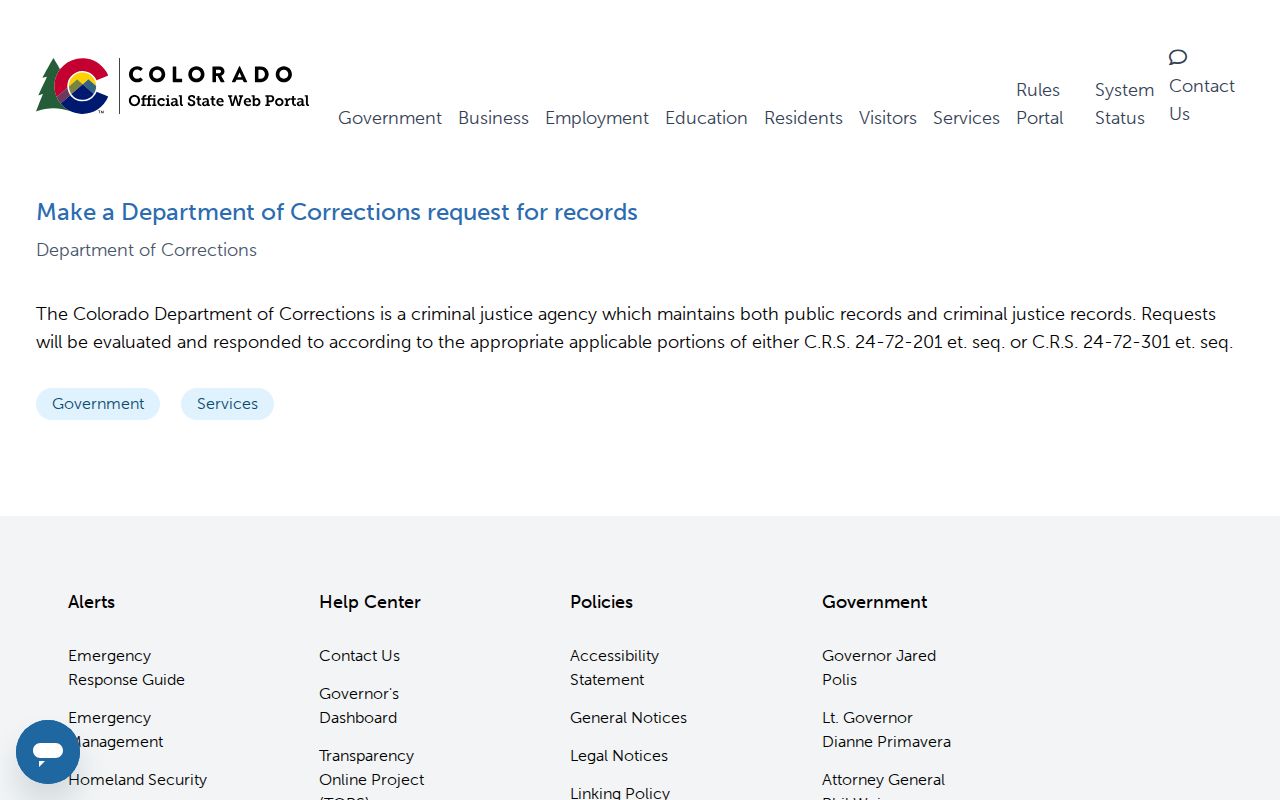
Colorado’s official service page states that CDOC maintains both public records and criminal-justice records. A narrow request is more useful than a demand for the complete file. Identify the person by full name, aliases, and DOC number. Add a date range and ask for the public time-computation or release record, actual prison-release date and type, parole-effective date if applicable, MRD, SDD, and public disposition information. State a preferred electronic format.
The official CDOC records-request service is the current principal route.
An older Time and Release Operations email remains in commented search-page source, but it is no longer a visible instruction and should be rechecked before use.
CDOC is a criminal-justice agency, so the Colorado Criminal Justice Records Act can govern access. Records of official action generally receive broader access than the rest of a corrections file. Exemptions and redactions can still apply. The public search is convenient, but the agency response is the better source for an exact release event or sentence calculation.
A focused request can also resolve conflicts between portal fields and other records. Quote the field at issue and give the date on which it was viewed. Ask CDOC to identify the public record that confirms or corrects it. If the question concerns a county-jail exit before the state sentence began, send that part to the sheriff or court instead of expecting CDOC to recreate a local booking history.
The Colorado online CORA request route provides broader statewide request context.
Criminal-justice requests still need to be directed to CDOC and framed around the specific official action or releasable record.